Wednesday, 22 August 2018

Learn - Scan

Yesterday I interviewed five of my target Māori students about their reading and writing habits at home and at school, both now and in the past. The code names for students remain the same.

I asked them what their reading habits were like at home:

Student 1 (e-asTTle reading level 4P)
Reads anime comics online, and they specified that these are both 'flicky' and downwards-scrolling texts. Student 1 "sometimes" reads offline.

Student 12 (e-asTTle reading level 3B)

Reads the Bible, and also visits the library to read 3x a week. Finds it too distracting to read at school.

Student 2 (e-asTTle reading level 3P)
Doesn't read at home, unless social media posts count.

Student 15 (e-asTTle reading level 4P)

No reading at home other than flicking through junk mail like newspapers and fliers.

Student 6 (e-asTTle reading level 3P)

Never reads at home.


I asked them what reading activities were like in Primary school, and all of them reported taking turns reading sentences or paragraphs in a book, being asked to summarize, and then answering questions about the text.

I found this interesting because students' didn't mention practicing identifying key points (without just reading out a full sentence), evidence, perspectives, key words and definitions - although this could have happened during the 'questions about the text' stage.

I asked them what strategies they would use to read a difficult science text.

Student 1 (e-asTTle reading level 4P) would just jump straight in and begin to read.

Student 12 (e-asTTle reading level 3B) would skim and scan first, identify key words, then read. They would ask friends about any words they found hard.

Student 2 (e-asTTle reading level 3P) would look for definitions.

Student 15 (e-asTTle reading level 4P) would "start from the beginning."

Student 6 (e-asTTle reading level 3P) would "just read" and if there was a difficult word they would "search it up."

I asked them how engaged out of 10 they were in school, and in science (there may be some bias because they were reporting this to me, their science teacher!)

Student 1 was 6 when friends were away, 4 when they were present, and 10 engaged in science
Student 12 was 9 in school and 8 in science
Student 2 5 in school and 8 in science
Student 15 was 7 and 7
Student 6 was 7 and 5.

I asked them if they could describe what they were learning in science at the moment, and all of them said "energy" along with "types of energy, such as kinetic, sound, and how they can't be created and destroyed." Student 2 went back in time and said "babies, DNA and genes."

I asked them whether they write differently in other classes compared to science:

Student 1 and 12 spoke together and said that in English they do fiction writing, but science is more factual. That they would "write anything" in English and use their imagination, but that science required fact.
Student 2, 15 and 6 said they didn't know..

And finally I asked them whether they had learnt any writing strategies in science:

Student 1 said he learnt everything in English.
Student 12 said simple sentences and adverb sentences.
Student 15 said adverbs.
Student 6 just shrugged.

Thursday, 16 August 2018

ROUND TWO - Intro - Learn - Gather Evidence

Now the new junior curriculum is being implemented, it’s time to focus on how it is impacting achievement of Maori students in junior science.

The area identified as impacting learner achievement most significantly in our cluster is the ability of our students at all year levels to read and write.

What is the problem, what is currently being done, what is working, and how can we improve?

There are six Maori students in my year 9 class. In answer to the question "what is the problem?" - let us look at their reading/writing e-aSSTle data. 

Students arriving at secondary school should be reading and writing at Level 4 or 5 of the curriculum. 

Only Student 15 is reading and writing at a level appropriate for a Year 9. 

Student 12 is writing at a Year 9 level but their reading is not, while Student 1 is able to read at a Year 9 age but their writing is at the level of an average New Zealand Year 5 or 6 student. 


What is currently being done? At Tamaki College we use the Accelerated Reader programme during Year 9 and 10 to increase the reading mileage of students, and scaffold their reading to a level that is both challenging yet achievable to them.

Students are guided to select books at the appropriate level (based on their initial scores and suggested Zone of Proximal Development) for them. Each day students read for a minimum of 20 minutes and during one English period a week they read for 50 minutes. When they complete a book, students complete a short quiz on the content of the book to check they read and understood it; score too low and they will be guided to an easier book, while a perfect 100% score means the book was too simple for them! The AR programme aims to extend students' reading abilities.

What is currently being done in science is largely up to the teacher. When I designed the new junior units I've tried to include some 'wide and deep' literacy units and each theme has readings attached to it. Now that I've progressed further through my inquiry into supporting literacy I realise there is so much more that can be done.

How can we improve?

That is the question that I will be focussing on during my second round of inquiry this year. I will still be focussing on Achievement Challenge 1: Raise Maori achievement through the development of cultural visibility and responsive practices across the pathway as measured by agreed reading targets for Years 1-10 and NCEA for Years 11-13.

However, I am also interested in writing, so some of that may creep in too!

I have given my second-round inquiry the title "Raising Maori student achievement by improving literacy in Science."


Here's the link to my initial outline.

Friday, 27 July 2018

Share - Reflect - Data Analysis

Week two with the Year 9 SOLO learning - does the pattern continue?
Week two is about the concept of natural selection!
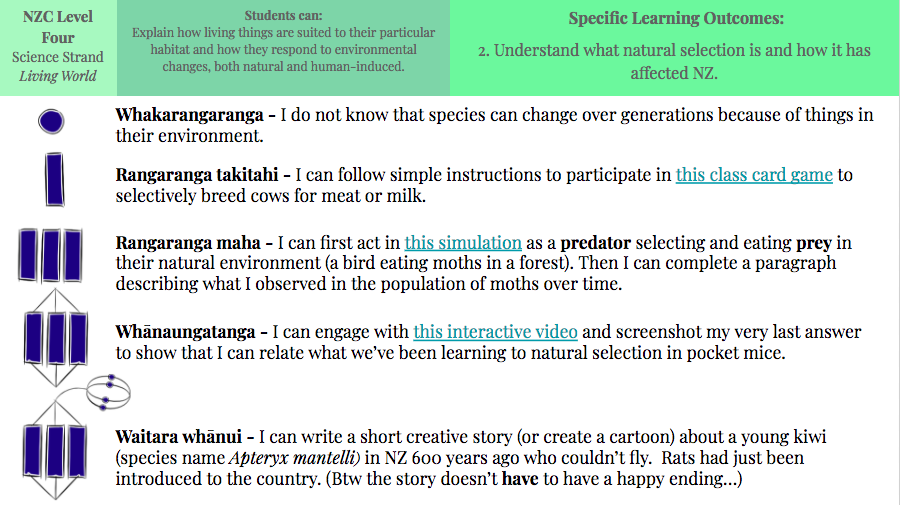
Here are the learning outcomes for each SOLO level:


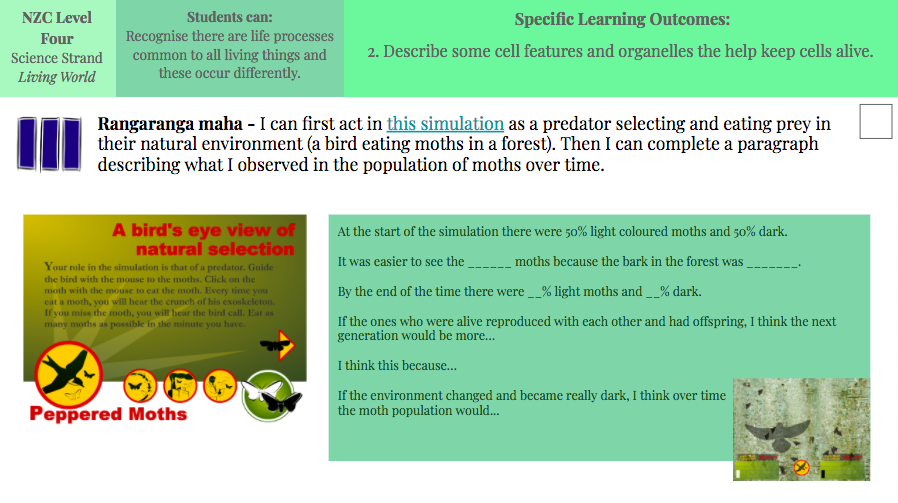
Here's what the rangaranga maha activity looks like:


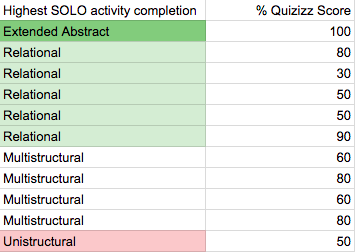
At the end of the week I gathered data using this quizizz (only 10 questions) and then plotted it against their highest level of work completion:


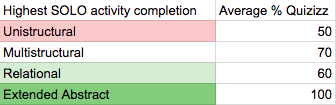
Next I found an average quiz score for those who completed each SOLO level:


I found a similar pattern to last week :)


Once again I showed this to the class to reinforce that the more effort you put in to your learning, the more you learn!  

Friday, 20 July 2018

Share - Reflect - Data Analysis

Is there any initial evidence to back up my idea that these SOLO-structured, literacy-focussed, culturally-located learning sequences support learning?

Well, when I created them - no. I went with my gut/teacher instinct and the readings/research I'd already completed, but I had to just make it and then see what happened. 

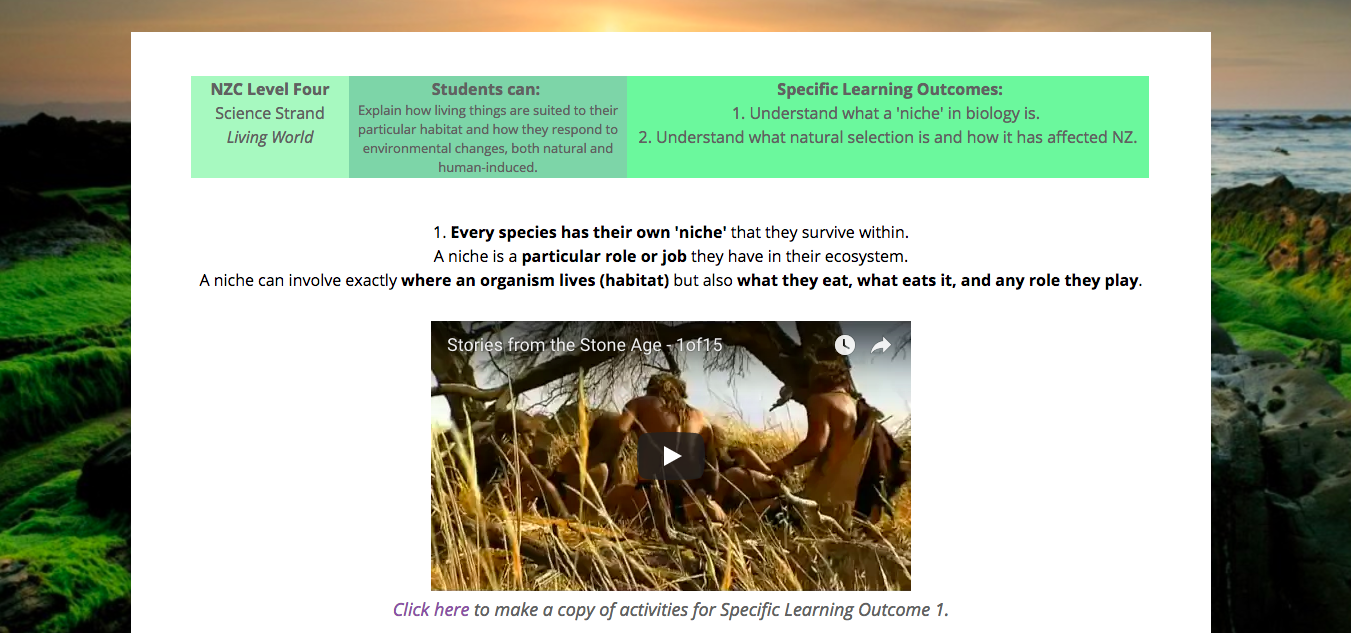
Let's have a look at how the learning went down with my Year 9 class - 9TGn. We began to learn about Ecosystems; in particular what an 'ecological niche' is.


First I introduced the topic and we watched the first 5 minutes of this video on stone-age farmers. Students were mostly engaged. Then they made a copy of the activities for Specific Learning Outcome 1

Over the course of the week students progressed at different speeds through the learning activities, with me able to float around and discuss the concept and try to motivate them onwards. Students asked for help at different places to one another.

The SOLO activities included students forming their own definition of what an ecological niche was my mixing and merging two online definitions. Then they moved on to complete a guided reading activity in pairs or small groups (which I have already blogged about here), a vocabulary activity that asked students to represent the vocabulary with an image AND in a sentence, and finally the last activity asked them to apply what they had learned about ecological niche's to their own lives (what is their own ecological niche?).

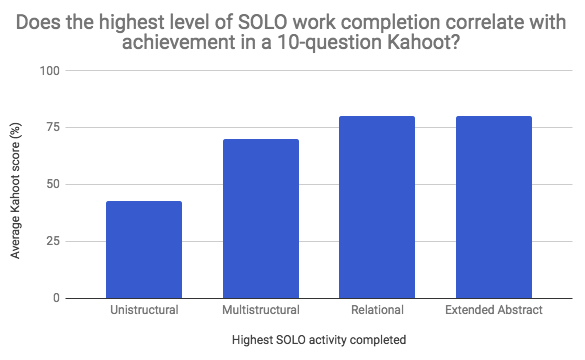
During the last 15 minutes on Friday we 'played' this 10-question Kahoot (which is actually a data-gathering tool for me). 

And LOOK at the glorious correlation between kahoot scores and the highest level of SOLO activity that was completed!!


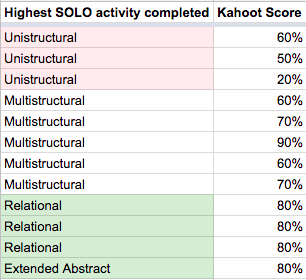
Here is the raw data I used to calculate the averages, if anyone is interested: 


In summary the further that students progressed through the learning activities, the higher they scored (on average) on the 10-question kahoot at the end of the week's learning. One exception to this was a student who only completed the Multistructural activity but scored 90% on the kahoot to take the win - but the overall pattern was still visible.

I will repeat this data analysis next week with a new SLO about 'natural selection.'


Friday, 13 July 2018

Share - Feedback and Feedforward

Now that the Y10 unit (and new Y9 Term 2 unit) are being implemented in junior classes, I need to consider how it can be sustainable and how it can be improved. Two questions to consider are:

1. How will I help sustain effective teaching practice with this new junior curriculum and format?
2. How can other science teachers reach me with questions / suggestions?

How will I help sustain effective teacher practice? Having the full year's plans already laid out in advance should improve consistency in learning experience at the junior level for some years into the future (until the NZC is changed, anyway). Teachers only need to look ahead to be ready for practicals and have enough crafty supplies to allow for some of the Extended Abstract activities. Some teachers have been making copies of all the activities to ensure they are familiar with and own the learning, and have then placed it onto their own sites so they can provide feedback for their students. I also ran a speedy tutorial on how to use the new site during a Science Department meeting, and made he screencast/video on my previous post. I have responded to a few email queries on how to run certain activities and manage the spreadsheet, and popped over to a colleague's room after school to help.

How can other science teachers reach me with questions / suggestions? I receive notifications of blog comments, and can also be reached at wells@tamaki.ac.nz, as well as the email address I used to create parts of this while I was overseas; scienceteacher90@gmail.com  So far my HoD has emailed to say one presentation had links to two videos but that both links went to the same video - that was a quick fix.

Friday, 6 July 2018

Share - Model - How to Use the Site

I created this video for students who are new to the Y10 learning format, but it could also be useful for teachers who didn't want to read my enormous last post! 


Friday, 29 June 2018

Share - Publish - New Year 10 Science Curriculum

I'm finally ready to share the new year 10 science curriculum that I've been working on and gradually tweaking and improving for SO long!

To make the year 10 curriculum flexible and trackable and linked to the only thing that doesn't seem to change in our world as teachers it is based off the New Zealand Curriculum (NZC).

It includes the:
Material World
Living World
Physical World and
Planet Earth and Beyond strands.  

Each strand in broken into three or four units that align with Level 5 of the NZC (where year 10 learning is supposed to be found). For example the material world strand in year 10 includes:

Atoms
Bonding
Periodic Table and
Fuels, as you can see below.


However to ensure that the year 10 programme is flexible and able to integrate and is thematic, each strand is broken down further into 'units' - the circles above you can see. These circles could be quickly combined together in any combination and linked to any theme. 


Above are four year-long programmes that different Year 10 classes could select from at the start of the year. Each Option includes all of the 'units,' but combines them in different ways and in different themes! For example, in Option 1 the first topic is called "Me in New Zealand." 


In "Me in New Zealand" students will learn about waves, the geosphere, atoms and genetic variation in the context of themselves and their lives in New Zealand. Together the class can first engage with two different readings; "Christchurch Earthquake Kills 185" and "Ancient DNA." 

Let's have a look inside the "Pressure" unit circle..


At the top of each 'unit' page there's links to the NZC and THREE specific learning outcomes (SLO's) listed. Each of these SLO's has a short paragraph introducing it, followed by a video or gif, and a link to the learning activities that support it. 

Let's click on the learning activity for SLO2... (if you would like to open it without making a copy, replace the word 'copy' in the URL with the word 'edit').


Ah, here we are. As you can see, it looks very similar! The SLO is listed in the top right corner. All activities to support the SLO are written as "I can" statements to help students articulate what they need to be able to do to achieve each level of SOLO learning. I've tried to build the activities up to support a good understanding of the SLO by the end. 

For example, the unistructrual activity just asks students to complete a cartoon about the definitions of mass and weight: 


By the end of the activities they'll be busy theorising, creating, analysing or any other Extended Abstract-level task. I've really tried to make extended abstract activities varied to suit different learning styles. Sometimes it's a short story, a video, an interview script, an analysis, a poem, a stop-motion animation, a hand-drawn cartoon, the conclusion of a scientific report, or even a painting of a concept using a selected artist model. 

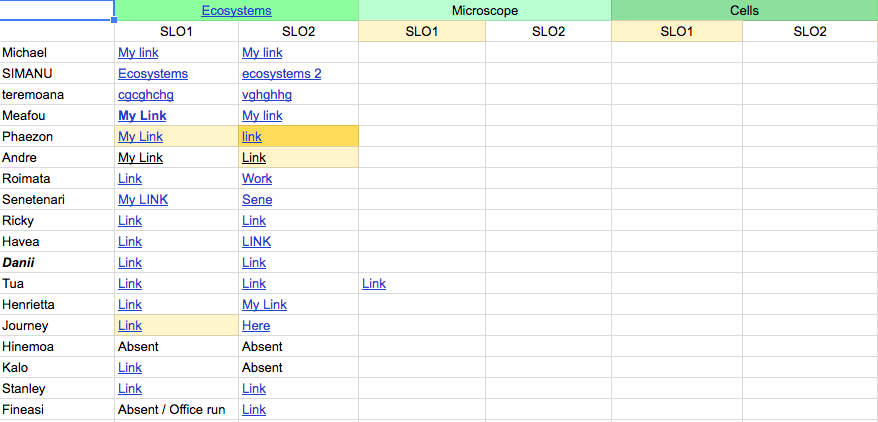
One key idea is that student must provide evidence of their learning back to that one copy of the learning activity that they made. At the start of the week students should share a link to their copy of the learning to a class spreadsheet, as shown below:


Sometimes tasks will lead them off to a website or quiz, and students will be asked to insert screenshots onto that one document/drawing/presentation as evidence. If they make a video or animation the onus is on them to provide a link to that on that one document. That means teachers just have to open provide feedback on just one document/drawing and they can all be found on the one spreadsheet. 

Grading is also nice and easy - I just created another sheet behind this first page. Students have access to view this but not edit it. 


Also, the spreadsheet lets teachers know when a practical is coming up; the SLO is coloured pale orange. 


Finally, a few of the 'units' are a bit different; they're based of the 'Wide and Deep' literacy units designed by Aaron and Naomi. Students engage with multiple texts from multiple perspectives (including a student-selected text on the topic) to more deeply understand a concept. A key word bank is explicitly required. The unit requires group reading and student-led discussions. A DLO is created at the end and shared to blogs.


Here is the link to my site, if anyone wants to visit :) I've linked you straight to Year 10 because Year 9 is only half complete. Once again, if you would like to open any activities without making a copy then replace the word 'copy' in the url with the word 'edit.' 

I would appreciate feedback!